Dick M. Carpenter, Ronald Reagan and the Redefintion of the “Education President”

This article appeared in the Texas Education Review’s Winter 2003-2004 edition as an online exclusive.

The article is good and works cited at the end is extensive.

You might be able to get a copy of the original via the Wayback Machine: https://web.archive.org/web/20040124134733/http://educationreview.homestead.com/.

By the way, the Texas Education Review once was a hotbed of conservative education reform scholarship. Click the above link and check out the masthead and contributors!
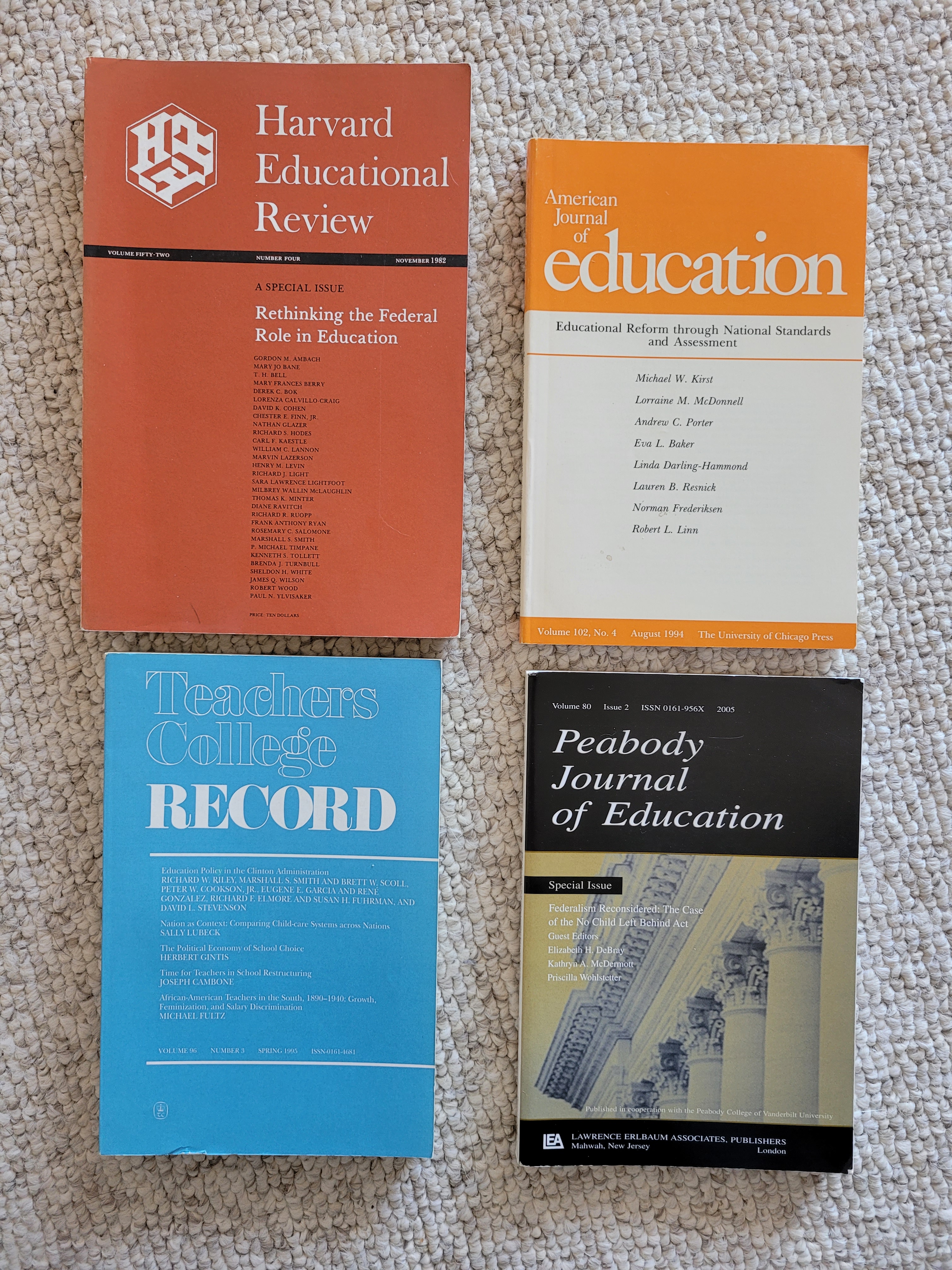
Big Debates About Federal Education Policy in Journals, 1982-2005

Big debates about federal education policy do not happen only on Capitol Hill. Academics and wonks have had some major conversations over the decades. Starting in the early 1980s, debates over disappointing educational achievement and what if anything the federal government could do (beyond providing still more resources) erupted. Below are four journals that had symposia on this meaty question. Authors included the heavies of the day, like Carl Kaestle, Diane Ravitch, Michael Kirst, and more. By no means is this list comprehensive—these just happen to be volumes that I came across during my research and that struck me as particularly smart and influential.

Harvard Educational Review, Rehinking the Federal Role in Education, November 1982

American Journal of Education, Educational Reform through National Standards and Assessment, August 1994

Teachers College Record, Education Policy in the Clinton Administration (symposium), Spring 1995

Peabody Journal of Education, Federalism Reconsidered: The Case of the No Child Left Behind Act, 2005

Gerald E. Sroufe, Politics of Education at the Federal Level

Gerald Sroufe, "Politics of Education at the Federal Level"

Why bother studying the federal politics of education?  Today, the question seems a little obtuse, what with the recent outpouring of studies on the topic.  But when Gerald Sroufe posed the question in 1994, it was not in jest.  The federal government supplied six to eight percent of school funding; it neither operated public schools (with rare exception) nor had it a significant a role in choosing what was taught in them.  So, was the politics of education really worthy of scholars’ time?

Sroufe answers this question emphatically in the affirmative. His first argument holds that the study of federal education politics furthers the conceptual analysis of politics. Continue reading “Gerald E. Sroufe, Politics of Education at the Federal Level”