
This study was published by the Institute for Human Studies, which is still very active.
Category: Laws
The short-lived Academic Competitiveness Grant program, 2006

This April 21, 2006 story in the Chronicle of Higher Education describes how Congress created the Academic Competititveness Grant (ACG) program. The program was part of a February 2006 omnibus law (P.L. 109-171) signed by President George W. Bush. The ACG was interesting for a few reasons:
- It is an example of Congress engaged in unorthodox lawmaking. The ACG apparently did not flow through regular order, with a bill introduced, referal to committee for study and amendment, etc. Some legislator added it to a deficit reduction package that runs 182 pages.
- The GOP-controlled Congress chose to give the GOP-led executive branch significant discretion to figure out how the program works. That’s not uncommon when the same parties controls the law-making and law-executing branches. But, lack of legislative clarity and failing to follow regular order means stakeholders can be awfully confused about what is happening. Which is what occured with ACG, according to the Chronicle story.
- The ACG was an unusual approach to school policy. It amended the Higher Education Act to offer additional Pell grant money to college students who had completed a “rigorous secondary school program of study.” So, on the one hand this is redistributive insofar as funds are only available to low-income individuals. On the other hand, it appears to be a roundabout way of trying to encourage schools to offer “rigorous” academic programs—that is, to raise education standards, which was a central goal of the Bush II administration. And, perhaps, it also aimed to fuel school choice by incentivizing low income students to mvoe to schools offering rigorous acadmeic programs.
- Last, the AGS statute created a council headed by the Secretary of Education to examine federal programs to improve math and science schooling—because there were concerns that American students were falling behind students in other nations. This resembles the motives that fueled the enactment of the National Defense Education Act of the Eisenhower era.
A 2006 Congressional Research Service report further describes the program, which ended in 2011. Presumably, President Barack Obama and congressional Democrats (who controlled both chambers, and neither wished to keep the program and simply ended it through executive action.
Remarks on the 40th Anniversary of the Establishment of the U.S. Department of Education: The Transformation of Federal Education Politics

Source: Cato.org. Kosar remarks start at 29:50.
Chris Cross and Ron Kimberling have spoken of the creation of the Department of Education and its earliest years in operation.
My own comments will focus on a broader issue of the Department of Education (ED) and the transformation of federal education politics. The establishment of ED was a major moment.
In short, the creation of the Department of Education rang the death knell for the very long national debate over the propriety of federal involvement in K-12 schooling.
Consider one point: Forty years ago, it was well within the bounds of political discourse to argue that we do not need a Department of Education. Today, anyone who takes that position waved off as a libertarian or troglodytic paleoconservative. Today, you cannot be president by arguing that we really do not need a Department of Education. Continue reading “Remarks on the 40th Anniversary of the Establishment of the U.S. Department of Education: The Transformation of Federal Education Politics”
1833 act compensating Mississippi landowners to fund school building
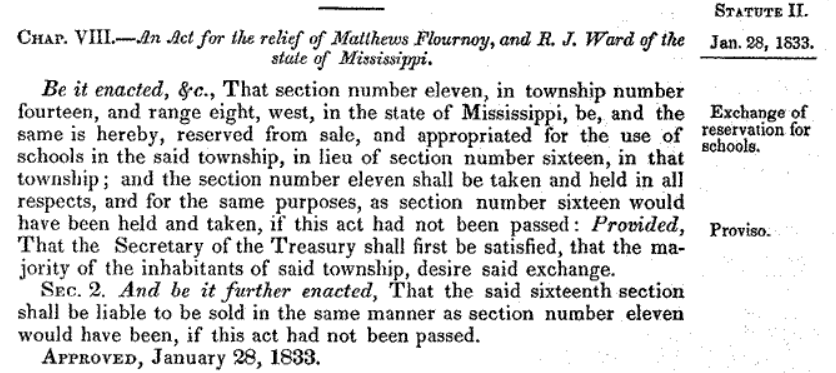
Here’s an interesting law. This private bill seems to have said that two individuals who owned land should be compensated for their land and the land be given to erect schools. How much they were to be compensated is unsaid. presumably that decision was delegated to the U.S. Treasury, but more research is needed.
 Federal Education Policy History