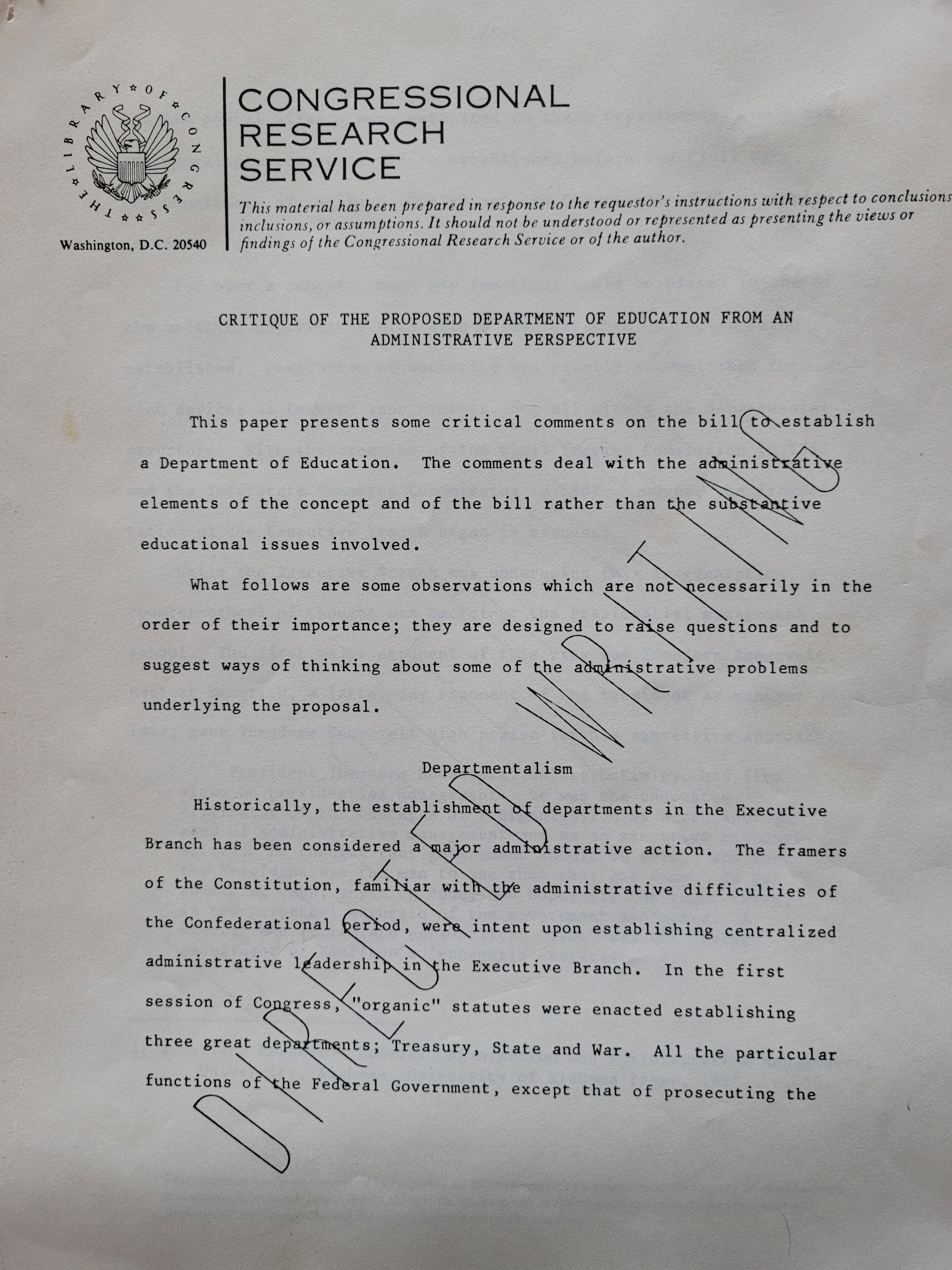
A memo questioning the wisdom of creating a U.S. Department of Education

The Congressional Research Service (CRS) is nonpartisan thinktank with the Library of Congress. It supports our national legislature in many important ways. At bottom, CRS provides a representative assembly comprised of diverse amateurs with something rare: trustworthy information and expertise.

One important but little known service CRS provides is critical feedback to legislators who request it. This can be delivered via a phonecall, in-person meeting, or written format. During my time at CRS, I frequently was asked to critique ideas for legislation and draft proposals. One particularly smart legislator sent me a white paper and asked me to “tear it apart.” Which I did in a lengthy memo that I wrote.

Continue reading “A memo questioning the wisdom of creating a U.S. Department of Education”
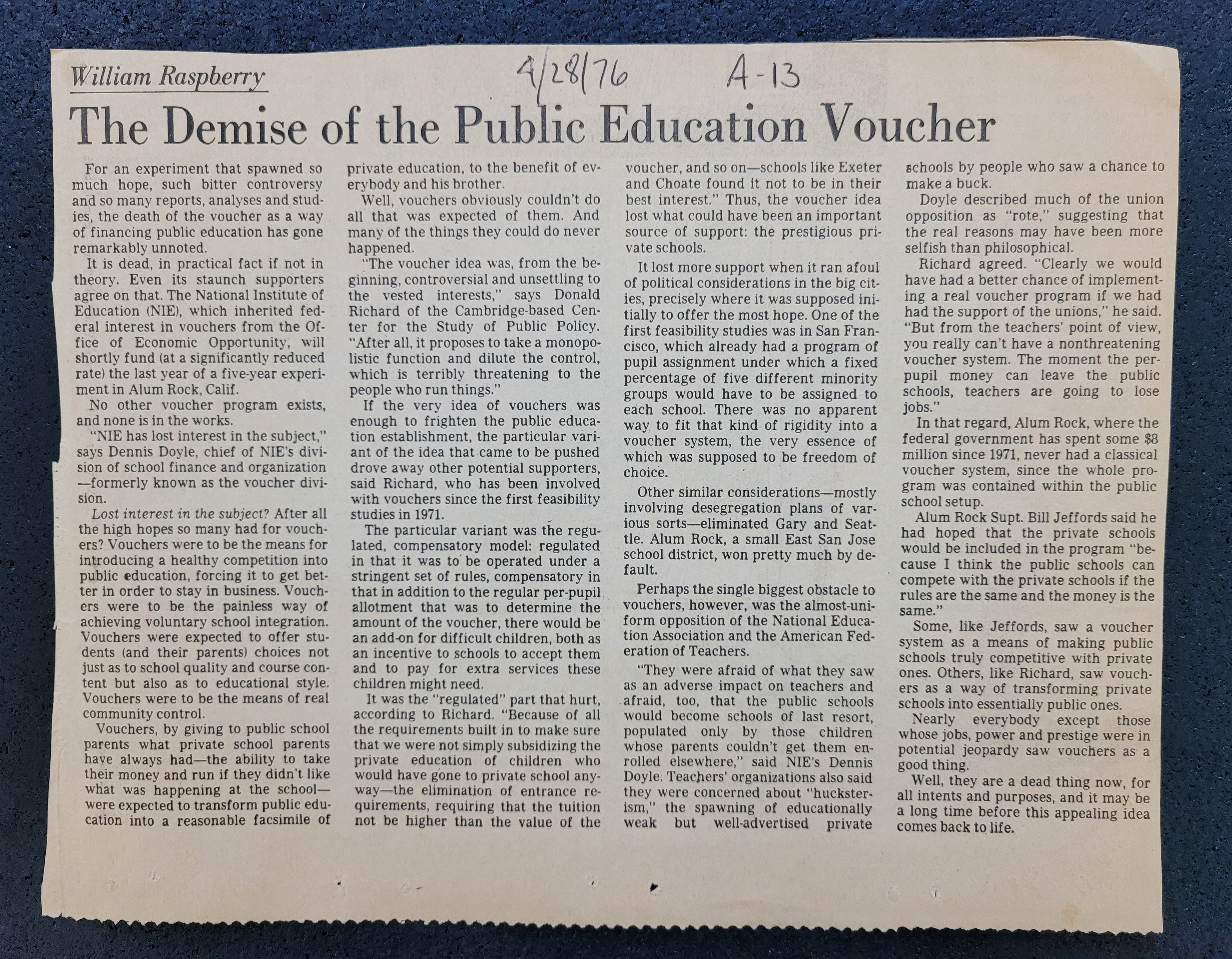
William Raspberry column on a forgotten federal voucher experiment, April 28, 1976

William Raspberry (1935-2012) was a great Washington Post columnist. He was a one of the first Black Americans to write for a major daily paper, and he was terrific at it. He won a Pulitzer and many accolades. His columns exuded commonsense, which all too often is in short supply in national debates. A professed liberal, he was anything but doctrinaire. He had a deep interest in real issues—poverty, crime, and equality of opportunity. And education, which he saw as being deeply intertwined with these matters.

This column was one of many he wrote on school choice. It is of particular interest to the federal Education Policy History site because it discusses a federal voucher experiment that few today know existed. His column describes the various special interests which stymied and killed the program.

Raspberry’s column also is a clarion reminder that school vouchers and choice has a complex history and should not be construed as a recent rightwing plot to defund the schools. For further information on the egalitarian origins of school vouchers, see Joseph P. Viteritti’s Choosing Equality: School Choice, the Constitution, and Civil Society (Brookings, 1999).

For further discussion of the Alum Rock experiment, see David W. Kirkpatrick’s Choice in Schooling: A Case for Tuition Vouchers (Loyola University Press, 1990).

Lyndon Baines Johnson, Special Message to the Congress: “Toward Full Educational Opportunity, January 12, 1965

LBJ Special Message to Congress 01-1965
Lyndon B. Johnson Message to Congress on Education, January 12, 1965. Source: The Association of Center for the Study of Congress


LBJ grew up in extreme poverty. He saw first-hand how schools could be the ticket out of a life of ignorance and hardscrabble survival. Johnson also knew that most schools got the preponderance of their funding through local property taxes. So, poor neighborhoods tended to have the schools ill-equipped to handle the “special needs” of their students. In a speech at the University of Michigan in 1964, LBJ declared,

“A third place to build the Great Society is in the classrooms of America. There your children’s lives will be shaped. Our society will not be great until every young mind is set free to scan the farthest reaches of thought and imagination. We are still far from that goal.”

This was the context for his push for the Elementary and Secondary Education Act of 1965, which was a key part of Johnson’s anti-poverty program.

Continue reading “Lyndon Baines Johnson, Special Message to the Congress: “Toward Full Educational Opportunity, January 12, 1965”

Federal Education Policy and Politics: Federalism and More

Source: Politico.com

In this article for Politico, I show how federalism has fostered a chronic ideological battle around the federal role in schooling. “The Constitution didn’t authorize the federal government to make schools policy. It is not among the enumerated powers in Article I section 8, and the 10th Amendment reserves powers not delegated to the federal government by the Constitution to the states and the people….” (Read more at Politico.com)

The below 1963 Herblock comic exhibits other aspects of the perennial politics of education: spending concerns, and the notion that federal school aid can and should reverse the effects of poverty and crime. (The comic is notably liberal—depicting the opponent of federal aid as old and and histrionic.)

Source: Library of Congress

Bureau of Indian Affairs Schools Records

Source: NARA.gov
Source: NARA.gov

The National Archives and Record Administration has the records of the Bureau of Indian Affairs, which operated schools for American Indians. The archival holdings are listed at: http://www.archives.gov/research/native-americans/bia-guide/schools.html. The federal government started making education policy for American Indians as early as 1819 with the Indian Civilization Act, which authorized funds to be granted to religious and private groups to school American Indians. (On the boarding schools, see here.) Eventually, the U.S. government itself via the Department of the Interior’s BIA began operating its own schools.