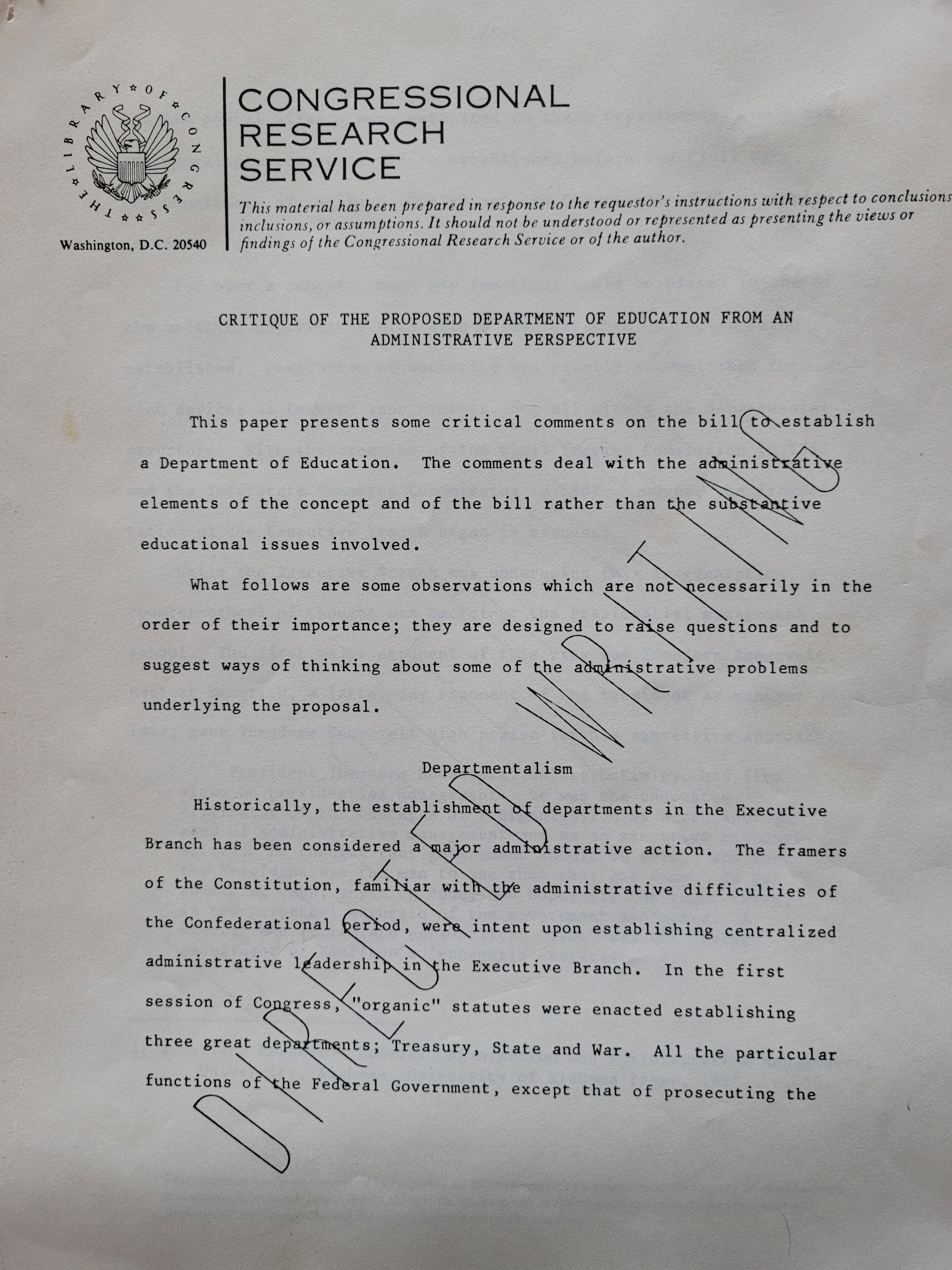
A memo questioning the wisdom of creating a U.S. Department of Education

The Congressional Research Service (CRS) is nonpartisan thinktank with the Library of Congress. It supports our national legislature in many important ways. At bottom, CRS provides a representative assembly comprised of diverse amateurs with something rare: trustworthy information and expertise.

One important but little known service CRS provides is critical feedback to legislators who request it. This can be delivered via a phonecall, in-person meeting, or written format. During my time at CRS, I frequently was asked to critique ideas for legislation and draft proposals. One particularly smart legislator sent me a white paper and asked me to “tear it apart.” Which I did in a lengthy memo that I wrote.

Continue reading “A memo questioning the wisdom of creating a U.S. Department of Education”
The Controversial and Condemned National Education Standards for History (1994)

The 1980s and 1990s saw a bipartisan push for national education standards. Unfortunately, when the history standards were released in 1994, a political firestorm erupted and the Senate voted to condemn the standards for being too politically correct. (For more on this story, see my book, Failing Grades: The Federal Politics of Education Standards (2006) and Diane Ravitch’s National Standards in American Education: A Citizen’s Guide (1996).

Copies of the standards, which were created by Charlotte Crabtree and Gary B. Nash, can be downloaded at https://eric.ed.gov/?q=title%3a%22national+standards+for+united+states+history%22&id=ED375076 and https://eric.ed.gov/?q=title%3a%22national+standards+for+world+history%22&id=ED375077.

Promising Results, Continuing Challenges: The Final Report of the National Assessment of Title I (1999)

This was an important report, as its findings about the Title I (formerly Chapter 1) program fed into the congressional discussions to rework the Elementary and Secondary Education Act of 1965 into the No Child Left Behind Act of 2001.

You can download a copy at https://eric.ed.gov/?q=title%3a%22promising+results%22&id=ED434418.

Digest of Education Statistics

Per the National Center for Education Statistics (NCES), “The primary purpose of the Digest of Education Statistics is to provide a compilation of statistical information covering the broad field of American education from prekindergarten through graduate school.”

You can download this particular volume at https://eric.ed.gov/?q=title%3a%22digest+of+education+statistics+1982%22&id=ED225272. Copies of volumes from the early 1980s through recent years can be found at https://eric.ed.gov/?q=title%3A%22digest+of+education+statistics%22. NCES offers copies (1995-present) online at https://nces.ed.gov/programs/digest/.

The annual Digest of Education Statistics and the annual Condition of Education (copies here) are go-to volumes for anyone studying the state of American schooling.

Scott Joftus and Ilene Berman, Great Expectations? Defining and Assessing Rigor in State Standards for Mathematics and English Language Arts

This 1998 report was publiched by the Council for Basic Education, an organization that was founded in 1956 to promote classical liberal education. It closed in 2004. A copy can be downloaded on Eric.gov at https://eric.ed.gov/?id=ED416080.

(Interestingly, CBE’s last leader, the late A. Graham Down, was my neighbor and was the teacher of Christopher DeMuth, who led the American Enterprise Institute from 1986 to 2008.)

It was one of many reports of the day that argued for rigorous education standards.