
The Congressional Research Service (CRS) is nonpartisan thinktank with the Library of Congress. It supports our national legislature in many important ways. At bottom, CRS provides a representative assembly comprised of diverse amateurs with something rare: trustworthy information and expertise.
One important but little known service CRS provides is critical feedback to legislators who request it. This can be delivered via a phonecall, in-person meeting, or written format. During my time at CRS, I frequently was asked to critique ideas for legislation and draft proposals. One particularly smart legislator sent me a white paper and asked me to “tear it apart.” Which I did in a lengthy memo that I wrote.
Some legislators want tough feedback to improve their proposals; other politicians want ammunitition to critique an idea they already have rejected. That’s politics. And to be clear, when CRS is asked to provide critical feedback neither the agency nor the analyst are taking a position. rather, the agency is doing what a legislator or committee has requested—providing criticism. So it would be an absolute error to look at a CRS critical feedback memo and infer, “Oh, the Congressional Research Service says…”
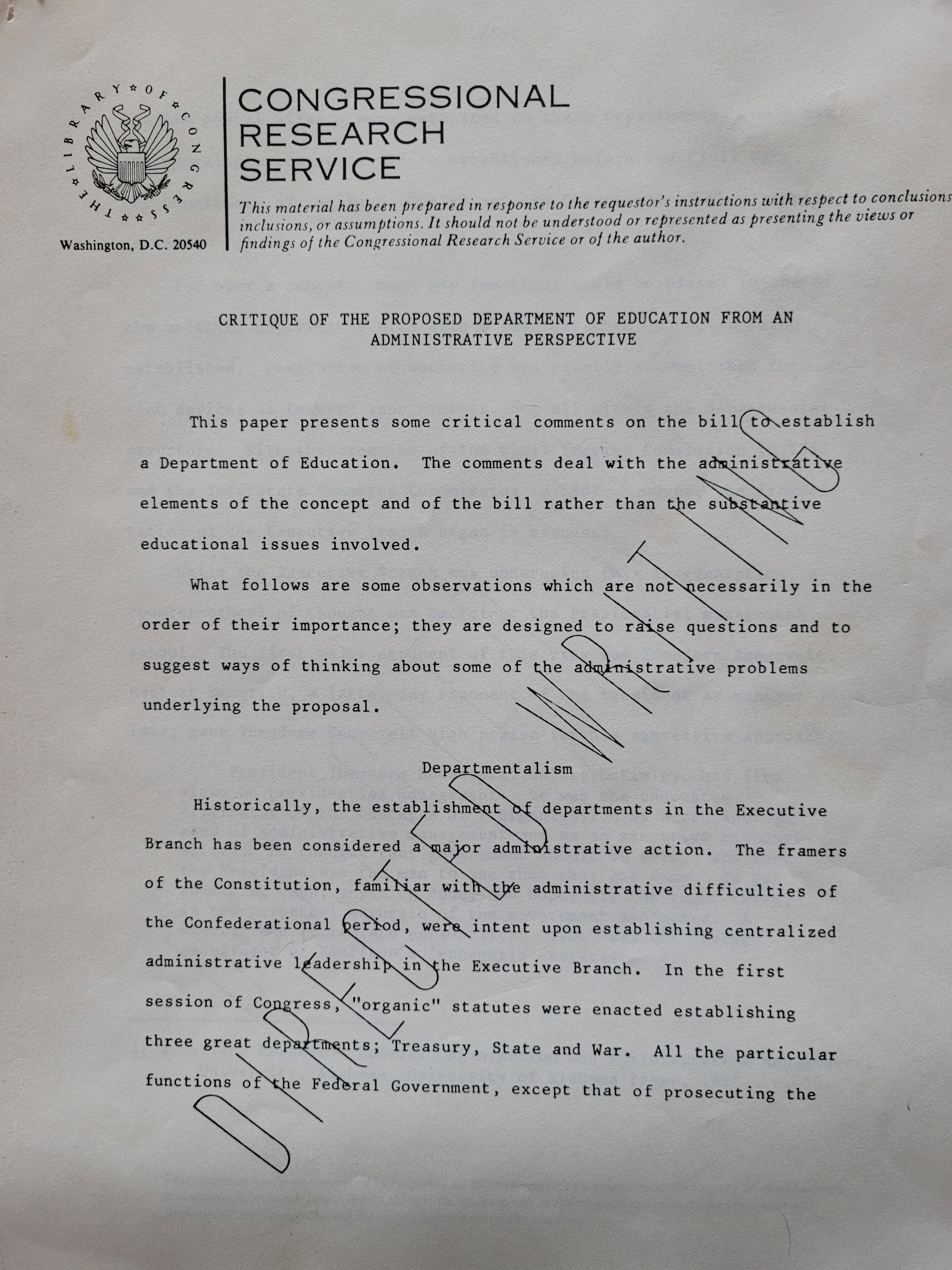
Below is a memo written by an expert at CRS in 1979 in response to a direct request from Congress. Whether it was a member or a committee who sought the memo is no matter. What is interesting is the author’s thinking about creating a Department of Education (ED) and its ringing conclusion: “[I]t is based on a questionable administrative theory. It will be … highly responsive to a relatively small interest group constiuency…. All in all it is a bad idea at the wrong time.”
Whether the memorandum changed any minds or affected legislation is unclear. Obviously, Congress did enact legislation to establish to create the ED. Democrats held strong majorities in both chambers and President Jimmy Carter had promised he would establish ED.
 Federal Education Policy History