
When Congress is pondering policy, it often turns to experts. This is a draft memorandum written sometime between 1985 and 1990. It aims to help Congress think through how it might best conduct educational research. Of particular value is the memorandum’s public administration perspective, which ponders the ways the agency might be structured to improve its odds of being effective.
Diane Ravitch, The Revisionists Revised: Studies in the Historiography of American Education (1977)
This 84-page long publication is, believe it or not, a book review. Well, it is a review of 10 books, written by Diane Ravitch.
And it is wonderful and withering. Ravitch casts a white hot light on the work of various lefty scholars and shows the various ways they politicized it and simply got history wrong. She closes her essay with a clarion call and an agenda for the field of study:
“History-writing has political impications; it influence public opinion and policymaking…. The most useful and relevant approach to educational history is that which seeks to determine how ideas are translated into policy, how policy is translated into practice, how practice grows into policy, how schools respond or fail to respond…. An understanding of the democratic process, a respect for rational inquiry, and a capacity for surprise are necessary equipment for those who attempt to reconstruct a sense of the past and to understand the role of education in it.”
One year after this review was published, Ravitch similarly-named, much expanded, book-length study was published: The Revisionists Revised: A Critique of the Radical Attack on Schools (Basic Books, 1978).
Harper’s Special Edition on Education, September 2001
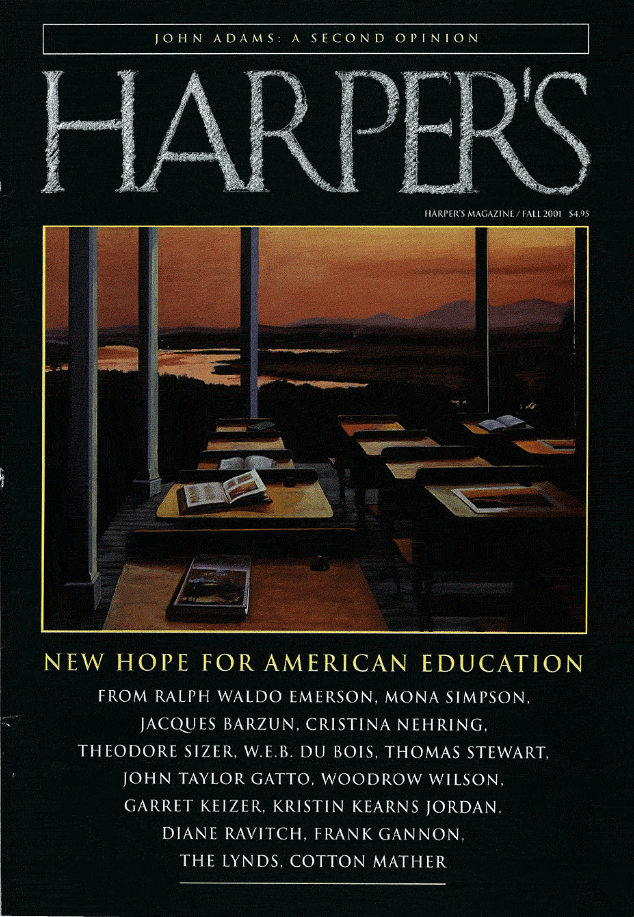
This is quite the collection of essays. Unfortunately, the issue landed the same month as the attacks of 9-11, and was less read than it might have been. You can acquire a copy from Harper’s at https://harpers.org/archive/2001/09/untitled-1136/.
Stephen Provasnik, Judicial Activism and the Origins of Parental Choice: The Court’s Role in the Institutionalization of Compulsory Education in the United States, 1891-1925

“Do I have to go to school?”
So many children have put this question to their parents or guardians. To we 21st century Americans, the question seems amusing. “Of course you must go.”
But compulsory schooling in the United States is a somewhat recent practice. From the days of the European settlement of North America through the early 20th century, all kids were not expected to attend school. Some localities and states enacted compulsor schooling laws, and hired truancy officers to nab urchins from the streets and haul them to class.
The question of whether government could rightly do that was fiercely debated. Ultimately, is the child the property of the parent? And how can a people be free if their children are forced into institutions to be “educated” in their duties as citizens? And doesn;t it trample upon religious freedom to require parents to submit thier children to schooling that conflcts with tenets of their faiths?
Ultimately, these local issues became a federal one via the federal courts.
For an introduction to this subject, see Stephen Provasnik‘s article, “Judicial Activism and the Origins of Parental Choice: The Court’s Role in the Institutionalization of Compulsory Education in the United States, 1891-1925,” History of Education Quarterly, fall 2006, https://eric.ed.gov/?id=EJ768604.
Stayner F. Brighton and Cecil J. Hannan, Merit Pay Programs for Teachers: A Handbook (1962)
In the early 1990’s, the idea of merit pay for teachers got hot. Like so many policy proposals, it was not a new one. This 1962 booklet reviews the copious evidence that existed at the time and does so in layman’s terms.
 Federal Education Policy History